How To Build A Pacing Plan For Long Events
Nailing your pace is essential in long cycling events. The right pacing plan removes the guesswork before your next event and helps you cross the finish line faster. The strongest plans are not built on a single fitness number, but on what you have actually done recently in training.
Key Takeaways
- Set your pacing target from what you have recently sustained in training at the duration you will be racing, not from a percentage of your FTP.
- FTP is a useful reference, but it is roughly a one-hour number and only one point on a power curve that is shaped differently for every rider.
- TrainerRoad’s Power Records tool shows your best power at every duration over the last six weeks, giving you a real number to pace from.
- When your event is longer than anything you have trained, use the Intensity Factor chart as a ceiling to estimate a realistic target.
Why do I Need a Pacing Plan?
Endurance sports are all about energy management. In a cycling race, energy is a precious commodity. The harder you go, the faster you burn through your reserves. Using a pacing plan will ensure you optimize energy expenditure. If you pace the event correctly, you’ll cross the finish line just as you’re using the last bit of energy. Go too hard and you won’t be able to finish strong. Go too easy, and you’ll lose time on the course.
Another benefit of preparing a plan is that you will reduce your cognitive load. Long events are stressful enough without having to calculate how hard you should be riding. Remove the guesswork beforehand and focus on hitting your target during the event.
What is a Pacing Plan?
A pacing plan is a decision you make before the event about how hard you will ride: the target power you aim to hold, and how you will spread your effort to hold it. Rather than riding on feel and hoping you judged it right, you commit to a number and a strategy ahead of time.
That target is described with two numbers. Normalized Power (NP) is the power your body actually experiences across a ride full of surges and coasting, rather than a simple average. Intensity Factor (IF) expresses that effort relative to your threshold. It is your NP divided by your FTP, so riding at an IF of 0.98 means you held 98% of your threshold power.
The reason IF is central to pacing is that the intensity you can hold drops as the duration climbs. You might sustain an IF of 0.98 for 45 minutes, but not for three hours. Shorter efforts allow a higher IF than longer ones, and once you pass about 90 minutes the drop-off flattens as the demand shifts almost entirely to the aerobic system. So the question a pacing plan really answers is not what percentage of your FTP to ride, but what you can actually hold for the duration of your event.
Pacing Strategy and Target Power
Start by identifying the key duration of your event, or the duration of the decisive effort within it, like a long climb. Then look at what you have recently held for that duration in training. If you’re pacing a 20-minute climb, look at your recent 20-minute efforts. If your event is around an hour, look at what you have held for an hour. For a long event, look at your longest recent sustained rides and how the power held up as they wore on. Adjusted for the demands of race day, that number is your target.
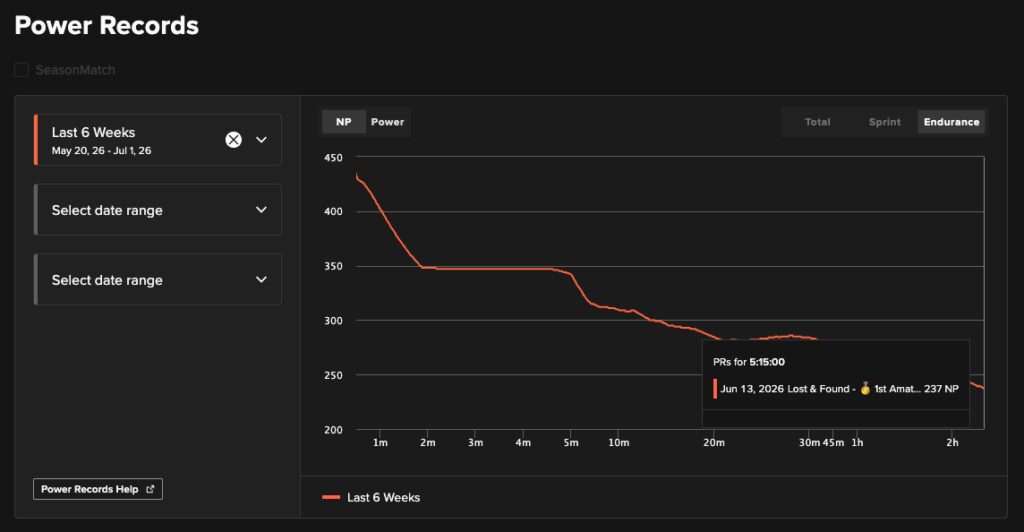
TrainerRoad’s Power Records tool makes this easy. It builds a power curve from your last six weeks of training and shows your best power at every duration, from a few seconds out past two hours. Hover over any point on the curve and it shows you the exact ride where you set that record. Find the duration that matches your event, and you have a real, current number to pace from.
When your event is longer than anything you’ve done recently, the chart below is a good starting point for IF. These recommendations are based on what we’ve seen as being possible for trained athletes. Depending on your level of experience, you may want to reduce the IF.
20 minutes – 1.05 IF
1 Hour – 1.00 IF
1.5-2.5 Hours – 0.90 IF
2.5-4.5 Hours – 0.80IF
4.5-16 Hours – 0.70 IF
To turn one of these guidelines into a target NP, multiply the IF by your FTP. For example, if your event is going to last three hours and your FTP is 270w, you would multiply 0.80 x 270w= 216w. Your target Normalized Power is 216w.
Now that you have a target power, you can take your pacing strategy a step further by planning how you are going to hit that target. The fastest pacing plans use a negative split. This is riding the first half of the course below your target, then over for the second half. By the end of your race, you will average the target power. Using the example above, a negative split would be to ride the first 1.5 hours at 208w, then ride the last 1.5 hours at 224w, for an average of 216w. Negative splits ensure that you don’t start too hard and allow you to push the pace in the latter part of the event. Negative splits are fun because it usually means you are passing other riders for the last half of the race.
With your pacing strategy in hand, you can go the final step and plan your nutrition. Finding your energy expenditure in kilojoules (kJs) is simple. Just multiply your avg. wattage by time in seconds, then divide by 1000. You can estimate your total time to get an approximate number to shoot for. 216w x 10,800 (3 hours in seconds) ÷ 1000 is 2,332kJs. Since a kJ is roughly equivalent to a Calorie, you can decide how you are going to fuel your ride.
Adjusting Your Pacing Plan Mid-Race
Sometimes you will need to change your plan mid-race. Your pacing plan should represent the ideal, but be ready to make adjustments. Maybe you’re just having a bad day, didn’t sleep well leading into the event, or didn’t eat enough breakfast. More than anything, nutrition and hydration will affect your pacing strategy. Make sure you are eating and drinking enough to give your body the fuel it needs to hit your numbers. Finally, race tactics can influence your plan. If you’re in a good group that’s not riding at your target, you may want to ride with them, until you find another. However, be cautious of expending too much energy early in the day to stay with a faster group.
For more on nutrition and pacing, check out Nutrition and Pacing Strategies for the Leadville 100.
Frequently Asked Questions
How do I set my pacing target for a long event?
Look at what you have recently sustained in training at the duration you will be racing, then adjust for race-day conditions. Recent efforts at the matching duration are a more accurate anchor than a percentage of your FTP.
Should I base my pacing on my FTP?
FTP can be a useful reference, but it two athletes with the same FTP can hold different power for 20 minutes or four hours, so pace off your recent training at the event’s specific duration.
What Intensity Factor should I target for my event?
Best approach is to look at you recent power curve for key durations, but if that’s not possible, IF can be helpful. As a rough guide, aim for about 1.05 for a 20-minute effort, 1.00 for an hour, 0.90 for 1.5 to 2.5 hours, 0.80 for 2.5 to 4.5 hours, and 0.70 for 4.5 to 16 hours. Use these as a ceiling when you do not have recent training data at that duration.
Where can I see my recent power at different durations?
TrainerRoad’s Power Records tool shows your best power at every duration over your last six weeks of training and lets you trace each record back to the ride that set it.
What is a negative split?
A negative split is riding the first half of your event slightly below your target power and the second half above it, so you average your target and finish strong instead of fading.
See your own power curve. Power Records shows your best power at every duration over the last six weeks, so you can build your next pacing plan around numbers you’ve actually hit instead of a percentage of one number. Start your training at TrainerRoad.com.